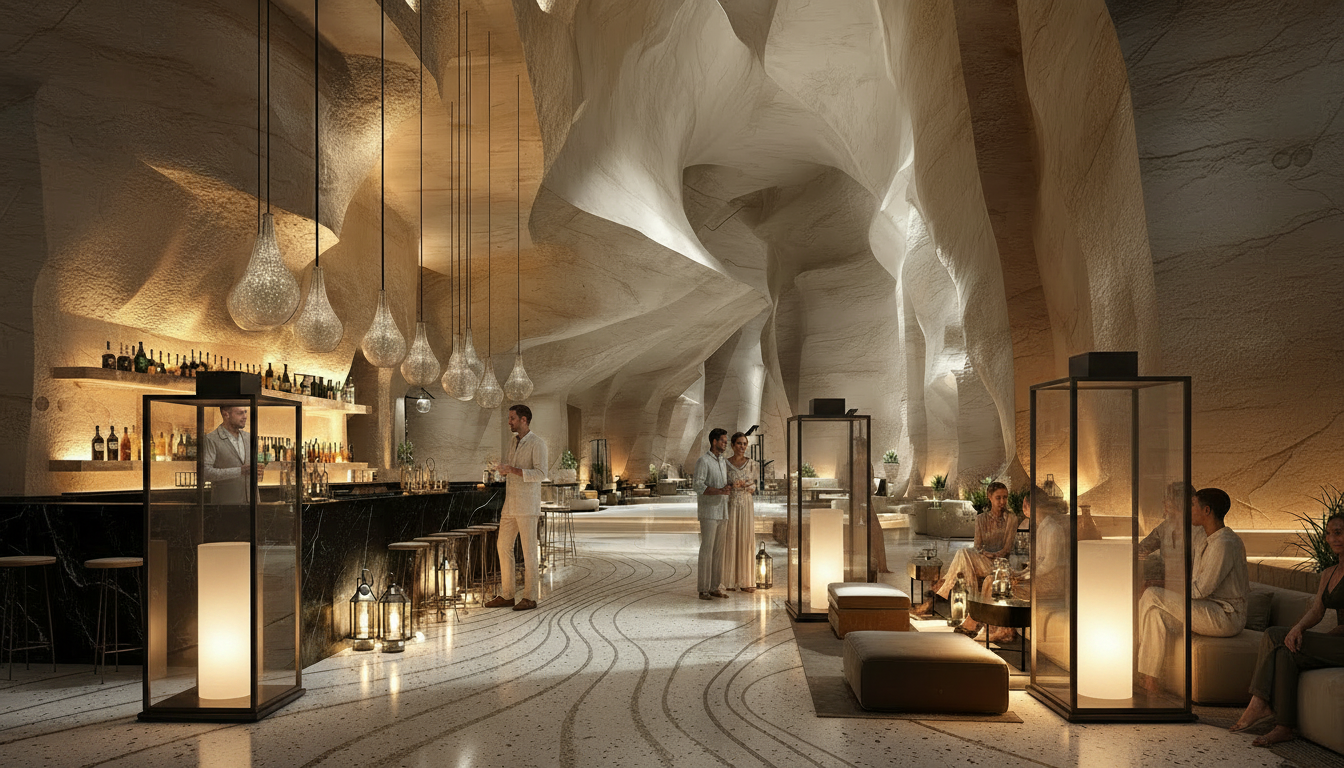
Whispering Dunes concept bar
If a guest understands the entire hotel within the first five minutes, what remains for them to discover?
For developers, the next frontier of luxury may lie not in revealing more, but in revealing it beautifully. Hospitality has become increasingly focused on immediacy. We want guests to understand the destination from the moment they arrive. We give them open sightlines, visible amenities, prominent signage and interiors designed to communicate everything at once.
The lobby, bar, restaurant, pool and retail are often revealed in a single panoramic gesture. It may be visually impressive. It may be operationally clear.
But is it Intriguing?
Some of the most memorable destinations in the world resist immediate comprehension. They do not surrender their entire story at arrival. Instead, they reveal themselves slowly, through a carefully choreographed sequence of thresholds, framed views, shifting light and unexpected encounters.
They understand that discovery is not simply a way of moving through architecture, It is an emotion.
The guest glimpses water through an opening in a stone wall but cannot yet see its source. A pathway disappears into a garden. A staircase rises toward a glow whose destination remains concealed. A quiet corridor opens unexpectedly onto a vibrant courtyard. A sculptural wall pivots to reveal an intimate bar known only to those who look more closely. A private terrace appears beyond what seemed to be the end of a passage.
Each revelation becomes an invitation to continue. This is the architecture of curiosity.
Designing the Unseen
Luxury is often associated with access: access to rare experiences, extraordinary places and worlds unavailable to everyone. Yet access becomes more emotionally powerful when it is preceded by anticipation.
The hidden garden feels more precious because it was not immediately visible. The private dining room feels more exclusive because reaching it required passing through a sequence of intimate thresholds. The view feels more breathtaking because the architecture concealed it until the exact moment of arrival.
The experience is shaped not only by what guests encounter, but by when they encounter it.
This is why discovery must begin at the master-planning stage.
It cannot simply be added later through styling, signage or decorative moments. It must be embedded in the relationship between architecture, landscape, circulation, programming and service.
Where does the guest’s gaze travel upon arrival? What is revealed immediately? What remains concealed? What draws them forward?
Where does the experience contract, and where does it suddenly expand? How does the destination change between morning and night, or between the first day and the fourth?
When these questions guide the planning process, circulation stops being merely functional. It becomes narrative. Movement becomes anticipation. And the hotel begins to unfold like a story.
Curiosity Without Confusion
Discovery does not mean making a destination difficult to navigate.
The finest hospitality environments allow guests to feel intuitively guided without feeling overly directed. There is a delicate difference between mystery and confusion. Confusion creates anxiety. Mystery creates desire.
Guests should always sense where they are being invited to go, even if they cannot yet see what awaits them. Light, sound, landscape, materiality and spatial proportion can quietly guide movement without relying on excessive signage or explanation.
A change in flooring may signal a more intimate experience. The distant sound of music may suggest a gathering beyond the next threshold. A line of lanterns may draw guests toward the garden at dusk. The scent of woodsmoke may lead them toward a hidden evening ritual.
These details create a form of intuitive wayfinding that feels emotional rather than instructional. The guest is not simply following a route. They are following curiosity.
When Guests Become Participants
A destination feels more personal when guests believe they have discovered something for themselves.
They may know, intellectually, that every moment has been designed. Emotionally, however, the experience feels like their own. This distinction matters.
A restaurant presented directly from the lobby is an amenity. A restaurant discovered beyond a lantern-lit garden can become a memory.
A lounge announced by prominent signage is a facility. A lounge revealed behind a bookcase, sculpture or shadowed passage can become a story guests cannot wait to share.
Discovery transforms guests from passive observers into active participants. It gives them a reason to wander, return and look again.
The first visit reveals one layer. The next morning reveals another. At night, familiar spaces take on new identities through light, music, ritual and changing patterns of activity.
The hotel never feels finished because the guest’s understanding of it continues to evolve.
The Commercial Value of Discovery
For developers, this emotional choreography also creates measurable value.vCuriosity encourages exploration. Exploration increases dwell time. Dwell time creates deeper engagement with restaurants, bars, retail, wellness, entertainment and cultural programming.
A guest who feels there is always something more to uncover is more likely to move through the destination, return to previously visited spaces and remain engaged across a longer stay.
Discovery can also create distinctive marketing value. In a world where spectacular interiors can be photographed, circulated and replicated almost instantly, an experience that unfolds gradually cannot be fully captured in a single image. It must be lived.
Guests share not only what they saw, but how they found it.
They tell stories about the concealed cocktail room, the sunrise garden, the private tasting chamber, the unexpected performance or the path that led them to an extraordinary view. These stories become part of the identity of the destination. They generate anticipation for future guests and deepen the emotional connection of those who have already visited.
Designing Beyond the First Impression
Hospitality places enormous importance on the first impression, and rightly so. But the first impression should not be the entire impression.
The most compelling destinations continue to reward attention. They offer details that are noticed only after several days, spaces that change with the hour and experiences that feel different depending on how the guest encounters them.
This is particularly important in resorts and large-scale hospitality developments, where size can easily become overwhelming or emotionally flat. A master plan may contain dozens of venues, but without narrative choreography, it risks feeling like a collection of disconnected amenities.
Discovery provides continuity.
Each experience becomes a chapter within a larger journey. The wellness sanctuary, signature restaurant, hidden garden, retail passage and nighttime venue no longer compete for attention. They build upon one another, creating a rhythm of anticipation and revelation.
The destination becomes more than a place to stay. It becomes a world guests feel compelled to explore.
The Luxury of What Comes Next
Perhaps true luxury is not having everything placed immediately before us. Perhaps it is the seductive sense that something extraordinary is still waiting beyond the next threshold.
The future of memorable hospitality will not be defined only by what developers create, but by how those experiences are revealed. Not everything needs to announce itself.
Not every view should be given away at arrival. Not every experience should be immediately understood.
Some moments should whisper. Some should remain hidden.
Some should be discovered only by guests willing to wander a little farther. Because when a destination reveals itself slowly, guests do more than move through it.
They become part of its unfolding story.
What could your destination become if it were master planned not simply as a collection of places, but as a story guests feel compelled to keep exploring?